
Advances in imaging and radiation technology are helping cancer specialists deliver more precise treatments and reduce side effects for patients receiving radiation therapy.
At Stillwater Medical’s cancer center, Medical Physicist Michael Chacko, says the ability to see what’s happening inside the body during treatment has significantly improved how radiation therapy is delivered.
“We obsess over millimeters of accuracy when delivering radiation,” Chacko said. “Our goal is to destroy cancer cells while minimizing the dose to normal tissue.”
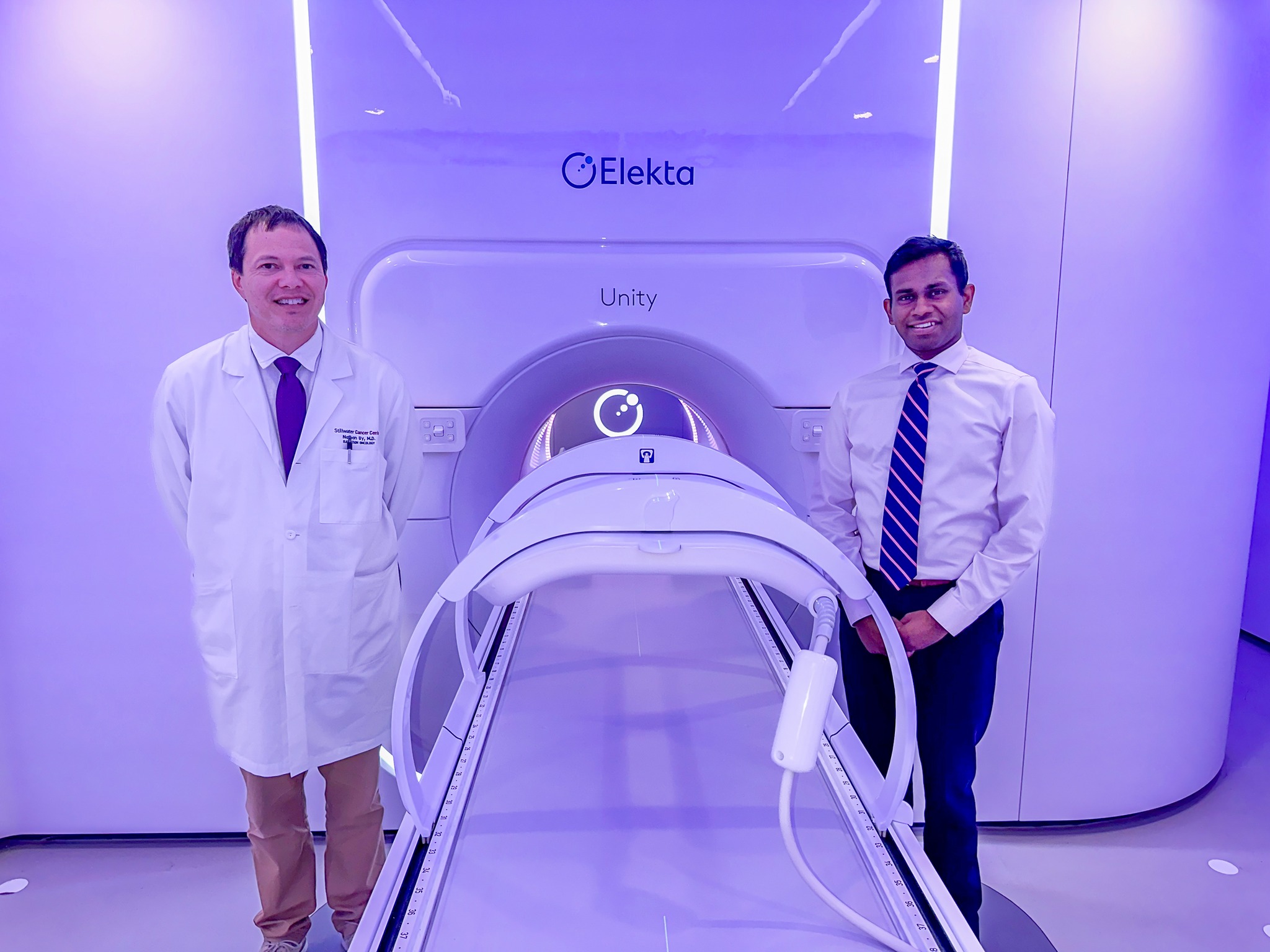
One technology helping achieve that goal is MRI-guided radiation therapy delivered through an MR-Linac, a system that combines magnetic resonance imaging with a linear accelerator that delivers radiation.
Traditional radiation therapy typically relies on imaging taken before treatment begins. Physicians create a treatment plan based on those images and follow that plan through a series of treatment sessions that can last several weeks.
However, the body can change throughout the course of treatment.
“You might start treatment with one set of images, but tumors can shrink and anatomy can shift over time,” Chacko explained.
MRI-guided radiation therapy allows clinicians to take new images each day and adjust treatment accordingly.
“We’re able to adapt the treatment plan the very day we’re delivering it,” he said. “We look at what’s going on inside the patient in real time and adjust the radiation plan right then and there.”
That precision allows radiation to more accurately target tumors while limiting exposure to surrounding organs and healthy tissue.
“For patients, that translates to less radiation dose to critical organs and fewer side effects,” Chacko said.
The technology is particularly effective for cancers located deep within the body, including prostate, rectal and abdominal tumors.
Another advantage is the potential to shorten treatment schedules.
“In the past, prostate treatments could take over 40 sessions,” Chacko said. “Over time that came down to around 20. Now for qualified patients, we’re able to offer treatment in five fractions.”
For patients traveling from surrounding communities, fewer treatments can significantly improve quality of life.
“We have patients who drive in from outside the area, including the Oklahoma City metro,” Chacko said. “Being able to complete treatment in fewer visits can make a big difference.”
As a medical physicist, Chacko works behind the scenes to ensure radiation treatments are delivered accurately and safely. His role includes calibrating the radiation equipment and reviewing each patient’s treatment plan to confirm the prescribed dose is delivered precisely.
“My job is to make sure the radiation goes to the right place and the right amount,” he said. “I review every treatment plan to make sure it’s the best way to deliver that radiation.”
Chacko says his interest in the field began early in life. His father worked as a medical physicist, and Chacko often spent time in cancer centers while growing up.
“I grew up in the radiation therapy environment,” he said. “I used to do my homework in the cancer center while my dad was working.”
Those early experiences gave him a unique perspective on how cancer treatment has evolved.
“When I was younger, I saw the side effects that came with radiation therapy,” Chacko said. “Over time, I’ve seen those dramatically reduced as technology has improved.”
It’s that advancement in technology that drew him to the Stillwater Cancer Center from the Oklahoma Proton Center a few years ago. Despite being a smaller community program, Stillwater Medical’s cancer center offers technology often found only at major academic institutions.
“We’re actually the smallest cancer center in the country offering this type of treatment,” Chacko said. “Most programs with this technology are large universities or major health systems.”
For Chacko, helping bring advanced cancer care to patients closer to home is one of the most rewarding aspects of his work.
“The exciting part is seeing how these advancements translate into better outcomes and better experiences for the people we treat,” he said.
He also emphasizes that while technology continues to improve cancer treatment, early detection remains one of the most important factors in patient outcomes.
“The difference between early and late detection is huge,” Chacko said. “All the technology in the world can’t help until someone takes that first step and seeks care.”
The Stillwater Cancer Center offers advanced radiation therapy, medical oncology, infusion services and supportive care in a patient-centered environment. A multidisciplinary team of specialists works together to create personalized treatment plans focused on improving outcomes and quality of life for every patient.